Vasanta Pañcamī
Māgha Śukla Pañcamī · The first day of spring, and the goddess of speech and learning
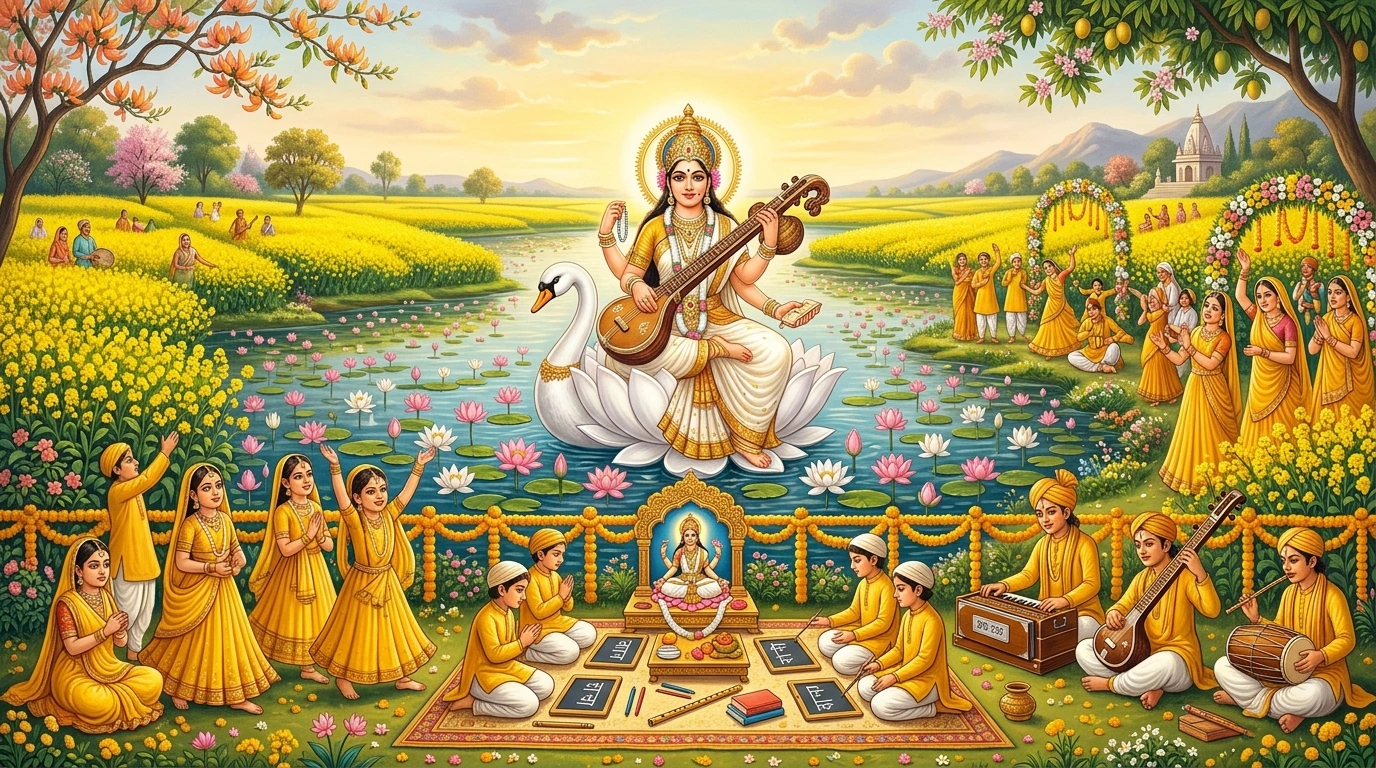
Vasanta Pañcamī
Vasanta Pañcamī celebrates the emergence of Goddess Sarasvatī, bringing wisdom, eloquence, music, and the first blossoming of spring. The tranquil morning hours foster intellectual receptivity.
The Significance of Vasanta Pañcamī
The goddess who gave the world its voice
Drawing on the Purāṇic tradition of Sarasvatī and the Devī Bhāgavata.
Vasanta is spring, and pañcamī the fifth day: Vasanta Pañcamī is the day spring is welcomed and the goddess Sarasvatī is worshipped, she of speech, learning, music, and every art.
The tradition tells that when the creator had made the worlds, he found them silent, formed, but mute, without speech or song or the power to know and name. From the creative word came forth a goddess, white-robed, seated on a white lotus, holding the vīṇā, a book, and the beads, and at her touch the silent creation found its voice: speech, melody, meter, the very capacity for knowledge. She is Vāc, the word itself made a goddess. Vasanta Pañcamī is held as her appearance, and the day she is honoured as the source of all learning.
The season is part of the meaning. The fifth day of Māgha’s bright fortnight is the threshold of spring, the mustard fields turning yellow, the cold breaking, the year’s first warmth. Yellow is the day’s colour everywhere: yellow clothes, yellow flowers, yellow sweets, the colour of the ripening fields and of Sarasvatī’s own light. Knowledge and spring are joined deliberately, the mind opening as the season does.
It is, above all, the day of beginnings in learning. The very young are given their first lesson, guided to write their first letter, akṣarābhyāsa, on Vasanta Pañcamī, so that learning starts under the goddess’s eye. Musicians and students place their instruments and books before her and do not study, but rest them at her feet for the day, taking up the work renewed the next.
What is done, and why
Sarasvatī is worshipped with white and yellow flowers, the vīṇā and books laid before her; children begin their letters; the household wears yellow and eats yellow sweets. Many keep the day free of study itself, the tools of learning are offered to their source and rested. There is no fast; it is a bright, gentle festival of the opening mind.
How it is kept
Vasanta Pañcamī falls on Māgha Śukla Pañcamī, the fifth day of the bright fortnight, the traditional first day of spring.
Why it is kept
The festival joins two openings: the season’s and the mind’s. The story of a silent creation given its voice is the tradition’s way of saying that speech, music and knowledge are not ours by right but gifts, and the day returns them, once a year, to the goddess who gave them, and starts the youngest of us learning under her name.
Source: The tradition of Sarasvatī as the goddess of speech and learning draws on the Devī Bhāgavata and Purāṇic accounts, available at wisdomlib.org.
How it is observed
Sarasvatī is worshipped with offerings of yellow; an auspicious day to begin a child’s first letters and for music and study. Yellow is worn.
- Dress in auspicious yellow garments (pītāmbara).
- Place musical instruments, notebooks, sacred books, and pens at the feet of Goddess Sarasvatī.
- Offer yellow marigold flowers, yellow mustard blossoms, and saffron-sweet rice (Mīṭhe Chāwal).
- Perform Akṣarābhyāsa (initiating toddlers into writing their first holy syllable “Oṁ”).
In Vedic astronomy, Rāhu is the shadow node (chāyā-graha) associated with illusion, darkness, and disruption. No new sacred endeavor, pūjā sankalpa, or idol installation (sthāpanā) should ever be commenced during Rāhu Kāla. Ongoing chanting or meditation may continue, but the initial invocation must never begin during this window.
Governed by Yama, the lord of mortality and justice. It is considered unfavorable for establishing enduring auspiciousness and prosperity; hence ritual beginnings and vows are suspended during this hour.