Gaṇeśa Caturthī
Bhādrapada Śukla Caturthī · The appearance of the remover of obstacles

Gaṇeśa Caturthī
In Vedic astronomy, daylight is divided into five equal segments: Prātaḥ, Saṅgava, Madhyāhna, Aparāhna, and Sāyaṅkāla. The Śiva Purāṇa and Gaṇeśa Purāṇa declare that Lord Gaṇeśa appeared during Madhyāhna (the midday third fifth of daylight). Gaṇeśa Avāhana (invocation) and Prāṇa Pratiṣṭhā (consecration of the clay idol) are uniquely performed at midday when solar and vital energies reach their cosmic zenith.
The Significance of Gaṇeśa Caturthī
The boy made of turmeric, and the head that was given
Retold from the Śiva Purāṇa, Rudra Saṁhitā (Kumāra Khaṇḍa). The English translation relied on here is that of J.L. Shastri (Motilal Banarsidass).
Pārvatī wished to bathe undisturbed, and had no one of her own to guard the door, Śiva’s attendants were Śiva’s, not hers. So she took the turmeric paste from her own body, shaped it into the form of a boy, and breathed life into him. He was hers alone, made from herself. She set him at the entrance with one instruction: let no one in.
When Śiva came and the boy, not knowing him, only keeping his mother’s word: barred the door, Śiva was refused entry to his own house by a child he had never seen. The quarrel escalated past reason, as such things do, and in the end Śiva’s forces, and Śiva himself, struck off the boy’s head.
Pārvatī’s grief turned the world dangerous. She had made this child from her own substance, and she would have the cosmos undone before she accepted his death. To restore him, Śiva sent his attendants to bring the head of the first creature they found lying with its head to the north, and they returned with the head of an elephant. Śiva set it upon the boy’s body and breathed him back to life. And then he did more: he made the restored child the lord of his own gaṇas, Gaṇa-īśa, Gaṇeśa, and gave him the standing boon that he would be worshipped first, before any god, at the beginning of every rite and every undertaking.
So the obstacle that was created, a locked door, a fatal misunderstanding between a father and a son who did not know each other, became, in its healing, the deity who is invoked to remove obstacles. The one who once stood in the way is now the one cleared first from the path.
The Moon’s Mockery and the Curse of False Accusations
Retold from the Brahmavaivarta Purāṇa (Gaṇeśa Khaṇḍa) and the Śrīmad Bhāgavatam (Skandha 10, Adhyāya 56–57).
On the fourth day of the bright fortnight of Bhādrapada, Lord Gaṇapati was returning home after enjoying an affectionate feast of steamed kudumulu (undrallu), modakas, and fruits offered in devotion across every household. As He rode His faithful mount, the little mouse (mūṣika), a serpent suddenly crossed their path. The mouse leapt aside in fright, and Lord Gaṇeśa slipped and tumbled, His round belly straining.
Looking down from the heavens, Candra (the Moon God), vain and proud of his fair countenance and celestial radiance, burst into loud, derisive laughter at the Lord’s form.
Indignant at Candra’s arrogance and disrespect toward the divine form, Lord Gaṇeśa pronounced a solemn curse:
“Because you are so swollen with vanity over your beauty that you mock the Divine, your light shall wane. Whoever looks upon your face on this day (Bhādrapada Śukla Caturthī) shall suffer Nīlāpavādulu (false accusations, malicious slander, and disgrace) throughout the year!”
Terrified, the Moon withdrew into hiding, and the universe was plunged into nocturnal darkness. The Devas and Sages gathered before Gaṇapati, singing His praises and pleading for mercy on Candra’s behalf. Lord Gaṇeśa softened the decree: the curse would not affect all nights, but on Bhādrapada Śukla Caturthī alone, looking at the moon brings the flaw (doṣa). He decreed that whoever faithfully performs His pūjā on this day shall be shielded from misfortune.
Even Lord Kṛṣṇa Suffered the Curse: The Syamantaka Gem
To demonstrate the inescapable power of Gaṇapati’s ancient decree, eras later in the Dvāpara Yuga, even Lord Śrī Kṛṣṇa was subject to it.
On a Bhādrapada Caturthī evening in Dvārakā, Kṛṣṇa happened to look into a bowl of fresh cow’s milk, and unwittingly caught the reflection of the crescent moon.
Soon after, King Satrājit, an ardent devotee of Sūrya who possessed the miraculous Syamantaka Maṇi (a solar gem that produced eight bhāras—over 170 pounds—of pure gold every single day, while banishing famine, pestilence, and drought), lent the radiant jewel to his brother Prasena. Prasena wore the blazing gem around his neck on a royal hunt into the deep jungle and never returned.
Satrājit openly accused Kṛṣṇa in the public square:
“Kṛṣṇa always coveted this jewel for the Dvārakā treasury! He must have murdered my brother in the forest and stolen the Syamantaka Maṇi!”
The scandal raged across Dvārakā, staining the Lord’s spotless name.
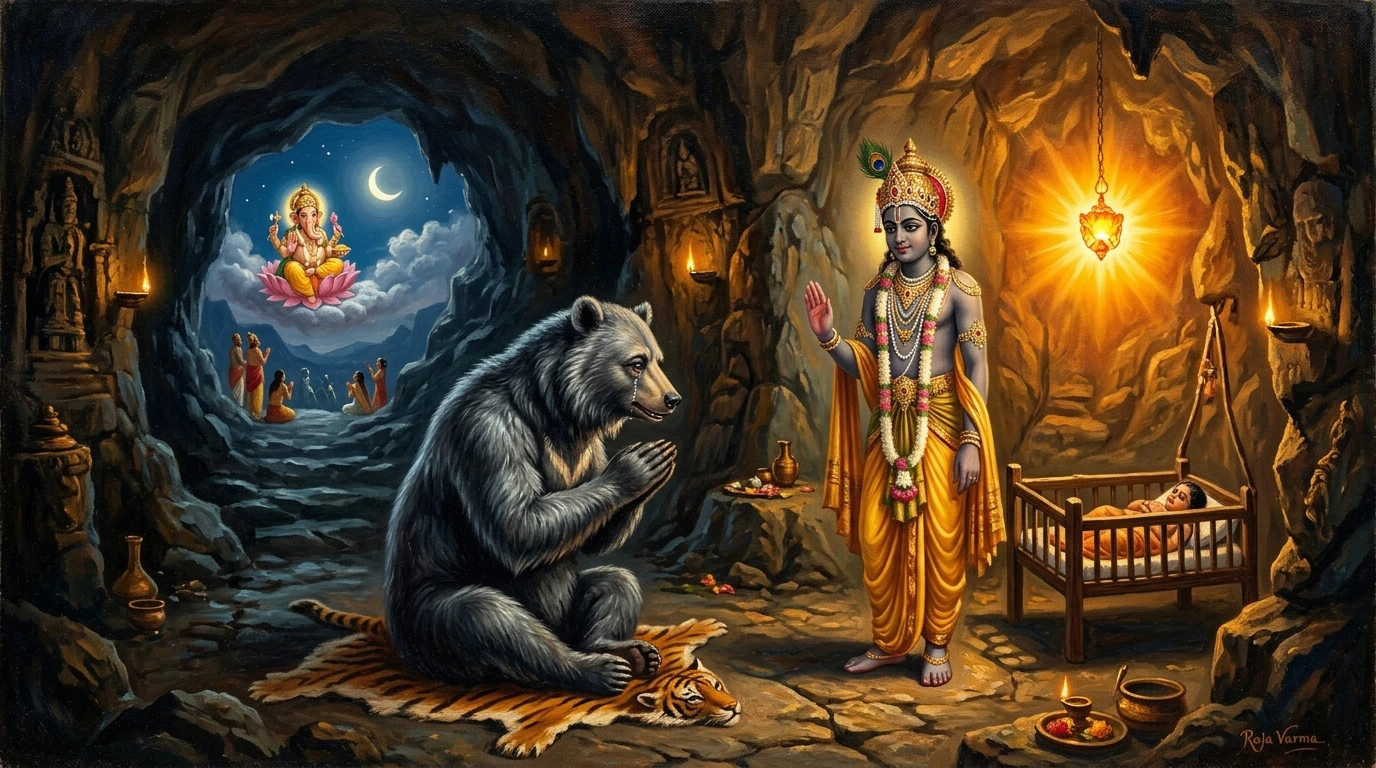
The 28-Day Cave Duel with Jāmbavān
To vindicate His honor, Kṛṣṇa tracked Prasena into the primeval forest:
- He discovered Prasena and his horse slain by a ferocious mountain lion.
- Tracking the lion, He found the lion killed by an enormous bear.
- Following the giant bear tracks into a dark mountain cave (the cavern of the Ṛkṣas), Kṛṣṇa heard a nurse rocking a child in a cradle, singing a lullaby:
सिंहः प्रसेनमवधीत् सिंहो जाम्बवता हतः। सुकुमारक मा रोदीस्तव ह्येष स्यमन्तकः॥
Siṁhaḥ prasenam avadhīt, siṁho jāmbavatā hataḥ | Sukumāraka mā rodīs tava hyeṣa syamantakaḥ ||
The Syamantaka gem was swinging over the infant’s cradle as a plaything. The guardian was Jāmbavān, the immortal bear-king and devoted servant of Lord Śrī Rāma from the Tretā Yuga. Not recognizing Kṛṣṇa in the dim cave, Jāmbavān attacked.
The two engaged in a titanic, bare-handed wrestling duel that shook the earth for twenty-eight continuous days and nights.
At last, his breath labored and strength failing, Jāmbavān recognized the divine touch: No mortal, titan, or god could ever surpass my strength—this is none other than my beloved Lord Śrī Rāma, returned as Kṛṣṇa!
Weeping tears of bliss, Jāmbavān bowed low with folded hands, surrendered the Syamantaka gem, and offered his daughter Jāmbavatī in marriage to the Lord.
Vindication and the Sacred Remedy Imparted by Sage Nārada (Prāyaścitta)
Kṛṣṇa returned to Dvārakā, convened the royal assembly, and placed the dazzling Syamantaka Maṇi before Satrājit, narrating the entire truth. Shamed by his reckless slander of the Supreme Lord, Satrājit offered both the gem and his daughter Satyabhāmā in marriage to Kṛṣṇa.
Even with His honor vindicated, Lord Kṛṣṇa asked the royal assembly: “I am the Lord who bears malice toward none. Why did such an outrageous, humiliating accusation befall Me?”
At that moment, the celestial sage Devarṣi Nārada arrived at the Dvārakā court. Nārada revealed the ancient cause:
“O Kṛṣṇa! In the primordial era, Lord Gaṇapati cursed the Moon on Bhādrapada Śukla Caturthī. You inadvertently caught the reflection of that very moon in the bowl of milk! Even the Supreme Lord is not exempt from the cosmic decree of Gaṇeśa’s word.”
When Kṛṣṇa asked what remedy mortals could observe if they accidentally caught sight of the Caturthī moon, Sage Nārada imparted the sacred remedy (prāyaścitta):
- Worship Lord Siddhi Vināyaka on Bhādrapada Caturthī with devotion.
- Listen to or recite this entire Syamantaka Maṇi Upākhyānam.
- Recite the protective lullaby verse:
सिंहः प्रसेनमवधीत् सिंहो जाम्बवता हतः।
सुकुमारक मा रोदीस्तव ह्येष स्यमन्तकः॥
(Siṁhaḥ prasenam avadhīt, siṁho jāmbavatā hataḥ | Sukumāraka mā rodīs tava hyeṣa syamantakaḥ ||) - Place the consecrated turmeric rice (Akṣintalu / Akṣatas) upon one’s head.
Nārada declared that anyone who observes this remedy will be thoroughly absolved of the Candra Darśana Doṣam and shielded from all false accusations and calumny throughout the year.
What is done, and why
Gaṇeśa Caturthī is the great festival of this: clay images of Gaṇeśa are installed in homes and public pavilions, worshipped with modakas (his loved sweet), dūrvā grass, and red flowers, and after some days carried in procession and immersed in water, the visarjana: the Lord made of earth returns to the element, as Pārvatī’s boy of turmeric came from and returned to her substance. He is invoked first because he was given the first place; no beginning is made without him.
How it is kept, at midday
Gaṇeśa is held to have appeared at madhyāhna, midday, so the festival is reckoned by the Caturthī tithi prevailing at midday rather than at sunrise. It falls on Bhādrapada Śukla Caturthī.
Why it is kept
The story is about an obstacle and its transformation. A door that should not have been locked, a child and a father estranged by not-knowing, and out of the worst of it, by a mother’s refusal to lose her son, comes the very deity who clears the way for everyone else. We begin with Gaṇeśa because beginnings are exactly where obstacles wait.
Source: Śiva Purāṇa, Rudra Saṁhitā, Kumāra Khaṇḍa (the appearance of Gaṇeśa); Brahmavaivarta Purāṇa, Gaṇeśa Khaṇḍa (the Moon’s curse); and Śrīmad Bhāgavatam, Canto 10, Chapters 56–57 (the Syamantaka jewel). Available at wisdomlib.org.
How it is observed
The clay mūrti of Gaṇeśa is installed and worshipped at madhyāhna with modaka and dūrvā grass over the festival days, then carried in procession for immersion (visarjana). Those who fast keep the monthly Vināyaka Caturthī form, see the vrata.
- Cleanse the pūjā altar, spread a clean red or yellow cloth, and install the clay Gaṇeśa mūrti facing East or North.
- Perform Dhyāna (meditation) and Āvāhana (invoking Lord Gaṇeśa’s living presence into the mūrti).
- Offer Pādya, Arghya, Ācamana, and bathe the deity with Pañcāmṛta (milk, curd, honey, ghee, sugar) and sacred water.
- Adorn with candana (sandalwood paste), sindūra, sacred thread (yajñopavīta), and fresh red hibiscus flowers.
- Offer 21 blades of fresh Dūrvā grass (symbolizing renewal, resilience, and removal of all 21 worldly miseries).
- Present 21 Modakas or Laddoos as Naivedya, followed by burning camphor (Āratī) and circumambulation (Pradakṣiṇā).
In Vedic astronomy, Rāhu is the shadow node (chāyā-graha) associated with illusion, darkness, and disruption. No new sacred endeavor, pūjā sankalpa, or idol installation (sthāpanā) should ever be commenced during Rāhu Kāla. Ongoing chanting or meditation may continue, but the initial invocation must never begin during this window.
Governed by Yama, the lord of mortality and justice. It is considered unfavorable for establishing enduring auspiciousness and prosperity; hence ritual beginnings and vows are suspended during this hour.
Looking at the moon on Bhādrapada Śukla Caturthī is strictly proscribed by the Śāstras. The scriptures explain that beholding the moon on this night brings Mithyā Kalaṅka—unfounded accusations, false blame, and loss of honor.
सिंहः प्रसेनमवधीत् सिंहो जाम्बवता हतः । सुकुमारक मा रोदीस्तव ह्येष स्यमन्तकः ॥
“A lion killed Prasena; that lion was slain by Jāmbavān. Do not weep, gentle child; this Syamantaka jewel is rightfully yours.” (Chanting this verse or reading Bhāgavatam 10.56–57 neutralizes the Mithyā Kalaṅka if the moon was accidentally seen).