Ananta Caturdaśī
Bhādrapada Śukla Caturdaśī · The vow of the endless one, Viṣṇu beyond beginning and end
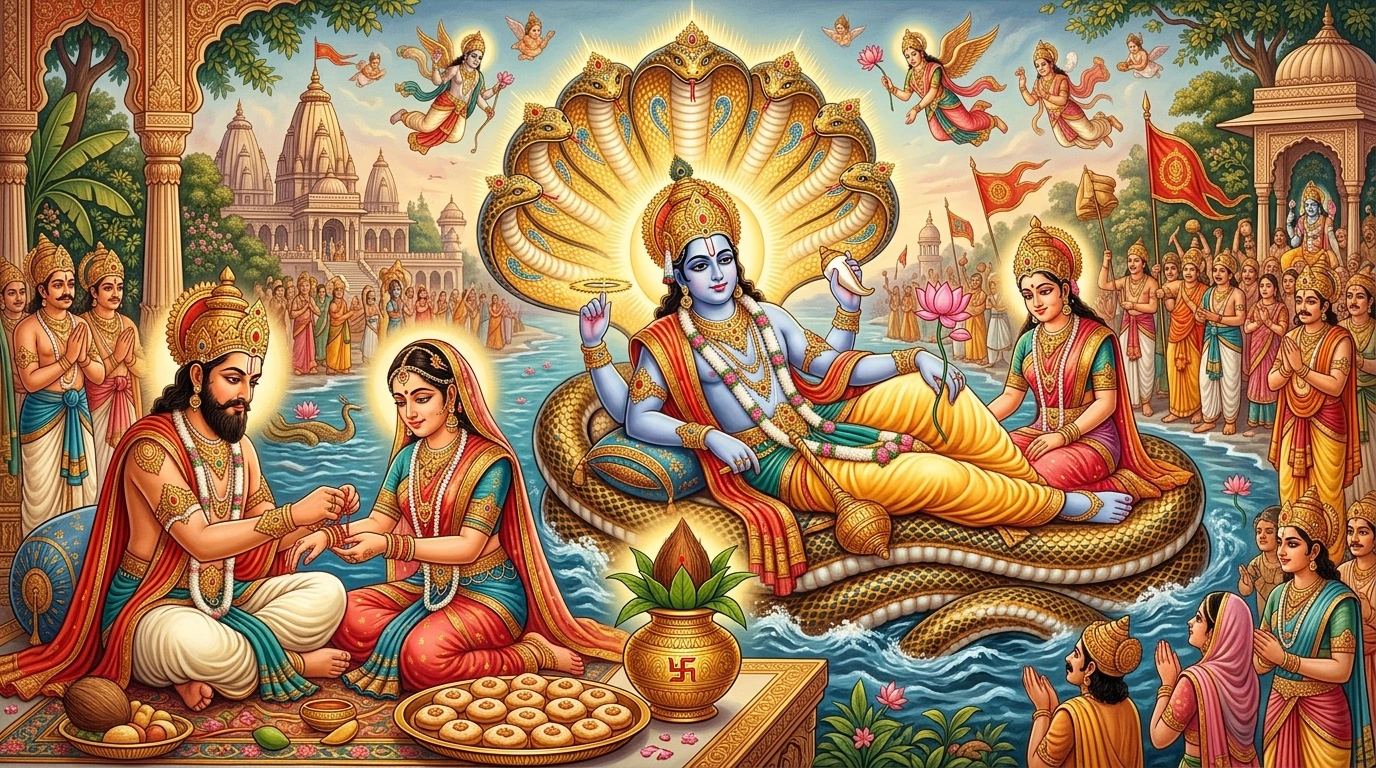
Ananta Caturdaśī
Midday is the traditional hour designated in the Bhaviṣya Purāṇa for tying the 14-knotted sacred thread of Lord Ananta-Viṣṇu (the boundless Lord resting upon the serpent Śeṣa).
The Significance of Ananta Caturdaśī
The fourteen-knotted thread
Drawing on the Bhaviṣya Purāṇa and the Mahābhārata, where Kṛṣṇa is said to give Yudhiṣṭhira the vow of Ananta.
Ananta means the endless, the one without beginning or end. It is a name of Viṣṇu, and of the cosmic serpent Śeṣa-Ananta on whose coils he reclines on the ocean between the ages. Ananta Caturdaśī is the day of the vow taken to him.
The Mahābhārata sets the vow in the Pāṇḍavas’ worst time. In the forest exile, stripped of kingdom and dignity, Yudhiṣṭhira asks Kṛṣṇa how the lost can be recovered, how a man brought down so far can rise. Kṛṣṇa gives him the Ananta-vrata: the worship of the endless Lord, and the tying of a thread of fourteen knots, dyed and consecrated, worn on the arm. The fourteen mark the fourteen worlds the endless one pervades, and the Caturdaśī, the fourteenth tithi, is its day. By this vow, Kṛṣṇa says, what has been lost is regained, as indeed, in the long arc of the epic, it was.
The deeper sense of the day is in the name itself. To worship Ananta is to fix the mind on what does not end, when everything that does end has fallen away. The Pāṇḍavas had lost the kingdom, the palace, the standing, every finite thing; the vow turns them, in that exact moment, toward the one thing that cannot be lost. The fourteen-knotted thread on the arm is a small endless thing worn against a season when everything finite has proven fragile.
Ananta Caturdaśī also closes the ten days of Gaṇeśa, and on it the great Gaṇeśa images are carried out for immersion, so the day joins a beginning’s deity to the endless one.
What is done, and why
The observance is the Ananta-vrata: worship of Viṣṇu as Ananta, often before an image of the serpent-couched Lord, and the tying of the consecrated fourteen-knotted thread (ananta-sūtra) on the wrist or arm, kept through the year. Fourteen kinds of fruit or sweets are offered. It is a vow especially of those who have suffered loss and seek restoration.
How it is kept
Ananta Caturdaśī falls on Bhādrapada Śukla Caturdaśī, the fourteenth day of the bright fortnight.
Why it is kept
The festival’s teaching is exact and consoling: when the finite has failed you, turn to the infinite. Kṛṣṇa gave the vow to men who had lost everything, and tied their hope to the only thing, Ananta, the endless, that loss cannot reach.
Source: The Ananta-vrata given by Kṛṣṇa to Yudhiṣṭhira is drawn from the Mahābhārata and the Bhaviṣya Purāṇa. The Mahābhārata is available at wisdomlib.org.
How to keep the fast
Worship of Ananta-Viṣṇu with the tying of the fourteen-knotted sacred thread (ananta-sūtra); many keep a fast through the day. It is also the day the Gaṇeśa festival ends in immersion.
Breaking the fast, Broken after the Ananta worship.
- Consecrate the sacred Ananta-sūtra (a cotton or silk thread dyed in turmeric with 14 knots representing the 14 cosmic realms).
- Offer 14 sweet wheat cakes (pūris) and fresh fruit to Lord Ananta Padmanābha.
- Men tie the consecrated thread on the right arm, women on the left arm, praying for eternal protection.
- Perform the joyful immersion (Visarjana) of the household Gaṇeśa idols with prayers for his return next year.
In Vedic astronomy, Rāhu is the shadow node (chāyā-graha) associated with illusion, darkness, and disruption. No new sacred endeavor, pūjā sankalpa, or idol installation (sthāpanā) should ever be commenced during Rāhu Kāla. Ongoing chanting or meditation may continue, but the initial invocation must never begin during this window.
Governed by Yama, the lord of mortality and justice. It is considered unfavorable for establishing enduring auspiciousness and prosperity; hence ritual beginnings and vows are suspended during this hour.