Holikā / Gaura Pūrṇimā
Phālguna Pūrṇimā · The full moon when devotion walked out of the fire unburned
Holikā / Gaura Pūrṇimā
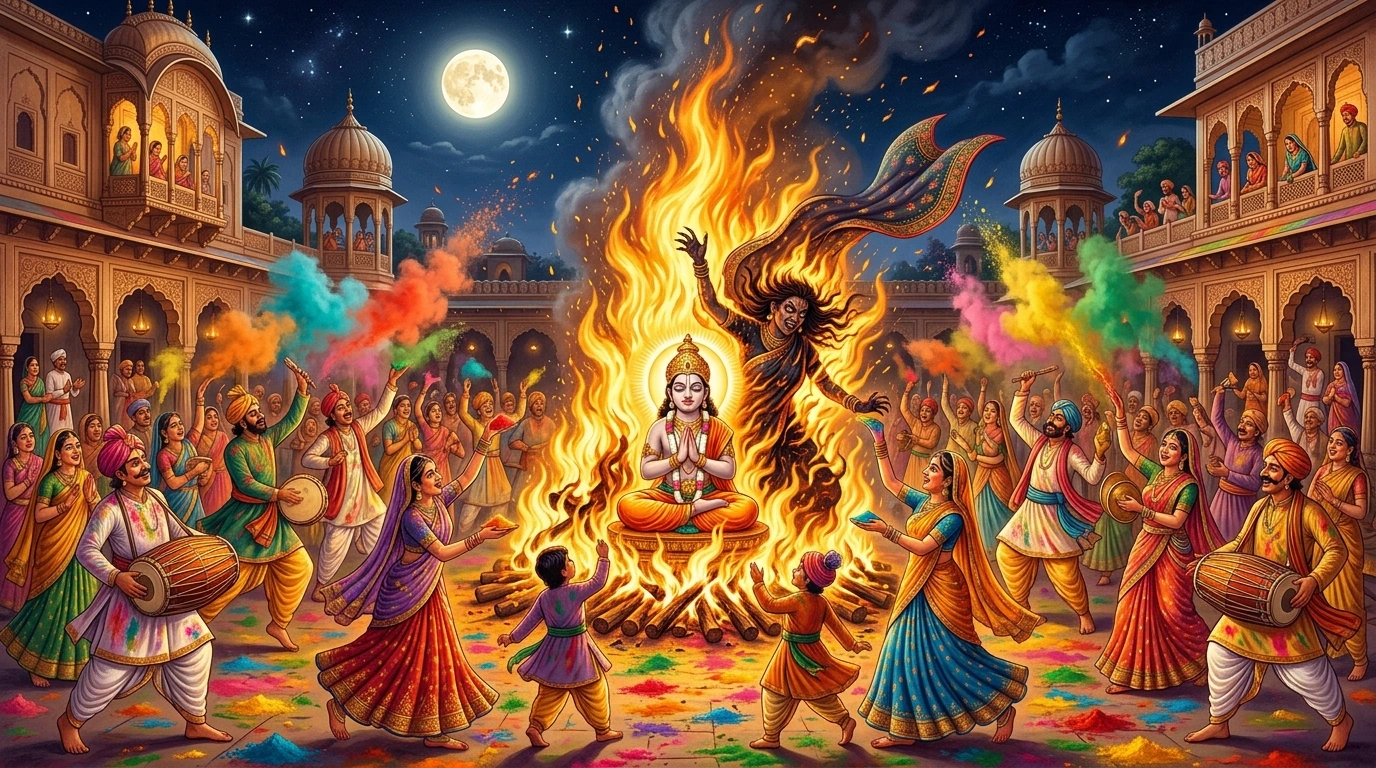
Holikā Dahana must be conducted after sunset on Phālguna Pūrṇimā. It commemorates the fiery ordeal where young Prahlāda was saved by devotion while the demoness Holikā was consumed by the very blaze she thought would destroy him.
The Significance of Holikā / Gaura Pūrṇimā
The fire that took the wrong one
Retold from the Bhāgavata Purāṇa, Canto 7, and the Viṣṇu Purāṇa. The English translation relied on here is that of A.C. Bhaktivedanta Swami Prabhupāda (Bhaktivedanta Book Trust).
The story belongs to the same house as Narasiṁha’s. The demon-king Hiraṇyakaśipu could not break his devotee-son Prahlāda, not by poison, not by weapons, not by serpents. So he turned to his sister, Holikā, who had a boon: a cloak (or, in some tellings, an immunity) that made her unburnable by fire. The plan was simple and cruel. Holikā would sit in the middle of a great bonfire with the boy on her lap; she would walk out unharmed, and Prahlāda would burn.
She took the child and sat in the flames. But the boon had a condition, it protected her only if she entered the fire alone, never to harm another, and used as a weapon against an innocent, it failed. As the fire rose, Prahlāda sat unmoved, his mind on the Lord, and the protective cloak lifted from Holikā and wrapped the boy. Holikā, the one who could not burn, burned; Prahlāda, who had no protection of his own, walked out of the fire untouched. Cruelty armoured by a boon consumed itself; devotion that asked for nothing was kept.
This is Holikā Dahan: the bonfire lit on the eve of the festival, in which an effigy of Holikā is burned: the yearly re-enactment of evil going up in its own flames while the good comes through. The riot of colour the next day, Dhulaṇḍī, the playing with colours that the festival is loved for, carries the joy of that deliverance, and the play of Kṛṣṇa and Rādhā and the gopīs in the Vraja spring, where Kṛṣṇa, dark, smeared colour on the fair Rādhā and so coloured the whole world.
The same full moon of Phālguna is Gaura Pūrṇimā, the appearance of Caitanya Mahāprabhu, the “golden avatāra,” dear above all to the Gauḍīya Vaiṣṇavas, who took birth, the tradition holds, under a lunar eclipse on this very night amid the chanting of the holy names.
What is done, and why
The eve is Holikā Dahan: a bonfire kindled at dusk, gathered around, the burning of the old year’s rubbish and of evil with it. The next day is colour: thrown and smeared on everyone alike, the one day the ordinary boundaries between people dissolve in a haze of red and yellow. For Gauḍīya Vaiṣṇavas the day is kept as Gaura Pūrṇimā with fasting till moonrise, kīrtana, and the appearance-festival of Caitanya.
How it is kept
Holikā Dahan and Gaura Pūrṇimā fall on the full moon (Pūrṇimā) of Phālguna; the colour-play (Holi proper) is the following day.
Why it is kept
The bonfire says what Narasiṁha’s pillar said: cruelty that armours itself burns in its own fire, and the devotee who carries no protection but his trust comes through unharmed. The colours the next morning are what that deliverance feels like, and on the same bright moon, the golden avatāra of pure love is born.
Source: The story of Prahlāda and Holikā is drawn from the Bhāgavata Purāṇa, Canto 7 (available at vedabase.io) and the Viṣṇu Purāṇa. Gaura Pūrṇimā follows Gauḍīya Vaiṣṇava tradition.
How it is observed
The Holikā bonfire is lit on the full-moon eve (Holikā Dahana), and colours are played the next day. Kept by Vaiṣṇavas as Gaura Pūrṇimā, the appearance of Caitanya Mahāprabhu.
- Assemble dry wood, cow-dung cakes (upale), and aromatic herbs around the central effigy.
- Perform Pūjā of the bonfire with water, garlands, turmeric, and roli.
- Light the sacred fire after sunset (strictly after Bhadrā ends).
- Circumambulate the fire three or seven times, roasting fresh wheat ears and coconuts in the flames.
- Collect the sacred ash (vibhūti) the following morning for protection before rejoicing in colours (Dhulandi).
In Vedic astronomy, Rāhu is the shadow node (chāyā-graha) associated with illusion, darkness, and disruption. No new sacred endeavor, pūjā sankalpa, or idol installation (sthāpanā) should ever be commenced during Rāhu Kāla. Ongoing chanting or meditation may continue, but the initial invocation must never begin during this window.
Governed by Yama, the lord of mortality and justice. It is considered unfavorable for establishing enduring auspiciousness and prosperity; hence ritual beginnings and vows are suspended during this hour.
Lighting the Holikā bonfire while Bhadrā is active is strictly proscribed and considered an omen of social and civic calamity.