Saturday, 12 October 1591
Fasting day
Sunday, 13 October 1591
Fasting day
Fast on Ekādaśī day. Break the fast strictly during this sacred Dvādaśī morning window with water, fruits, or light sāttvika food.
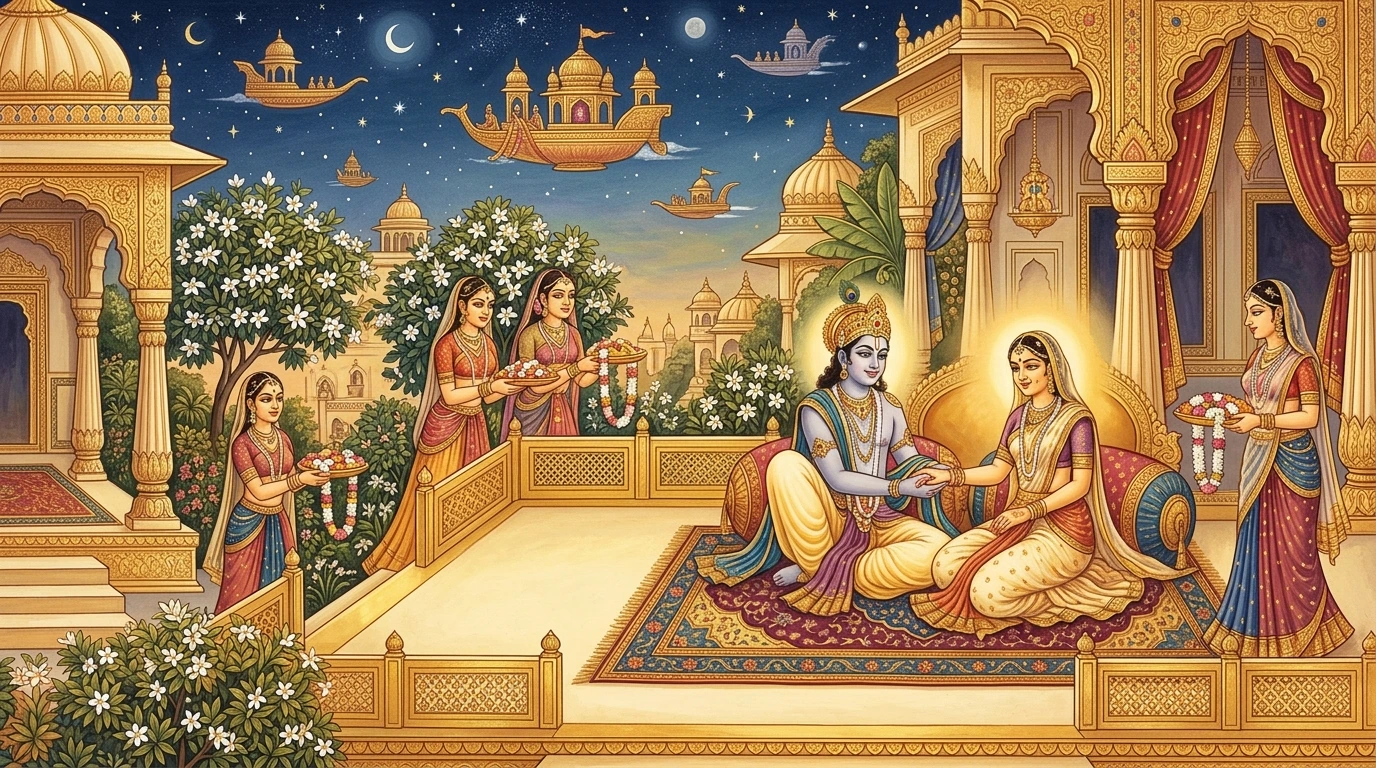
Mount Mandara: Prince Śobhana and Princess Candrabhāgā unite in an eternal celestial crystal kingdom made permanent by the lifelong merit of Ramā Ekādaśī.
*Showing Smārta date – Vaiṣṇava tradition observes on Sunday, 13 October 1591 →
Many keep a stricter fast from sunset the evening before.
Tulā Saṅkrānti
The Sun enters Tulā
Saturday, 12 October 1591
The Sun crosses at 8:13 AM, your local time
A bath in sacred water, the Tulā-snāna in the Kāverī is especially honoured, and charity.
The Sun enters Tulā (Libra), where day and night stand in balance. Kept as Tulā Saṅkrānti, and as Kati Bihu in Assam, a quieter festival of lamps in the fields and prayers for the ripening crop.
Daily Tithi, Muhūrtams & Horizon
Kṛṣṇa Pakṣa · Ekādaśī
followed by: Kṛṣṇa Dvādaśī12:05 PM – 12:53 PM
4:56 AM – 5:44 AM
9:31 AM – 11:00 AM
1:58 PM – 3:28 PM
6:32 AM – 8:02 AM
Bearings indicate horizon degrees. Rāhu, Yamagaṇḍa, and Gulika are avoided for new auspicious beginnings; Abhijit and Brahma Muhūrta are sacred windows for pūjā, chanting, and meditation.
Saturday, 12 October 1591 (today, in the ancient reckoning)
- Cosmic Time
अद्य · श्वेतवराह कल्पे · वैवस्वत मन्वन्तरे · कलियुगे प्रथम पादे
adya · śveta-varāha kalpe · vaivasvata manvantare · kali-yuge prathama pāde
In Śveta-varāha kalpa, Vaivasvata manvantara, and the first quarter of Kali-yuga, in the eternal presence of the Supreme Lord...
- Calendrical Time
शालिवाहन शके १५१३ · खर संवत्सरे · दक्षिणायने · शरद् ऋतौ
śālivāhana śake 1513 · Khara saṁvatsare · Dakṣiṇāyane · Śarad ṛtau
In the sacred cycle of the Śaka era, current Jovian year (Saṁvatsara), solar transit (Ayana), and season (Ṛtu)...
- Astronomical Limb (Pañcāṅga) · Pañcāṅga Kāla (Daily Alignments)
कार्तिक मासे · कृष्ण पक्षे · एकादशी तिथौ · शनि वासरे · आश्लेषा नक्षत्रे · शुभ योगे · बव करणे
Kārtika māse · Kṛṣṇa pakṣe · Ekādaśī tithau · Śani vāsare · Āśleṣā nakṣatre · Śubha yoge · Bava karaṇe
In this sacred lunar month, fortnight, lunar day, weekday, birth star, yoga, and karaṇa...
- Sacred Locality
जम्बूद्वीपे · भारतवर्षे*
jambū-dvīpe · bhārata-varṣe (India)
In Jambūdvīpa, the sacred land of Bhāratavarṣa (India)...
*The locality lines (jambū-dvīpe bhārata-varṣe): India is shown by default; spoken aloud you substitute your own region and town.
What You Just Read: The Three Frames of Time▾
What You Just Read: The Three Frames of Time
The saṅkalpa places the moment in three nested dimensions—cosmic, calendrical, and astronomical—so the seeker knows exactly when and where they stand in eternity.
Cosmic Time (Eternal Scale)
Cosmic time doesn’t change with where you read this. Śveta-varāha is the present kalpa (~4.32 billion years). Vaivasvata is the current manvantara. Kali-yuga prathama pāda places us in the first quarter of the dark age. Identical whether recited in Bengaluru, Mumbai, London, or New York.
Calendrical Time (Solar & Seasonal Cycles)
Calendrical time tracks the present era and season: the Śaka era (from 78 CE), the 60-year Jovian saṁvatsara cycle, Uttarāyaṇa or Dakṣiṇāyana (solar transit), and the bi-monthly ṛtu (season).
Astronomical Time (The Five Limbs of Pañchāṅga)
Astronomical time is the immediate daily rhythm: māsa (lunar month), pakṣa (fortnight), tithi (lunar day), vāra (solar weekday), nakṣatra (moon constellation), yoga, and karaṇa.
Local Sunrise Reckoning & Daily Purpose
All values above are calculated for your local sunrise. The day traditionally belongs to whichever tithi prevailed at sunrise.
The saṅkalpa is the daily (nitya) opening of sacred life. Recited each morning, it re-anchors you in awareness of eternity and dedicates your actions with resolve.
Found an error?
ekadasi.day has no ads and no popups. If a date, name, or story reads wrong, please write, accuracy matters more than reach.
mrvi@post.com →·Other ways to help